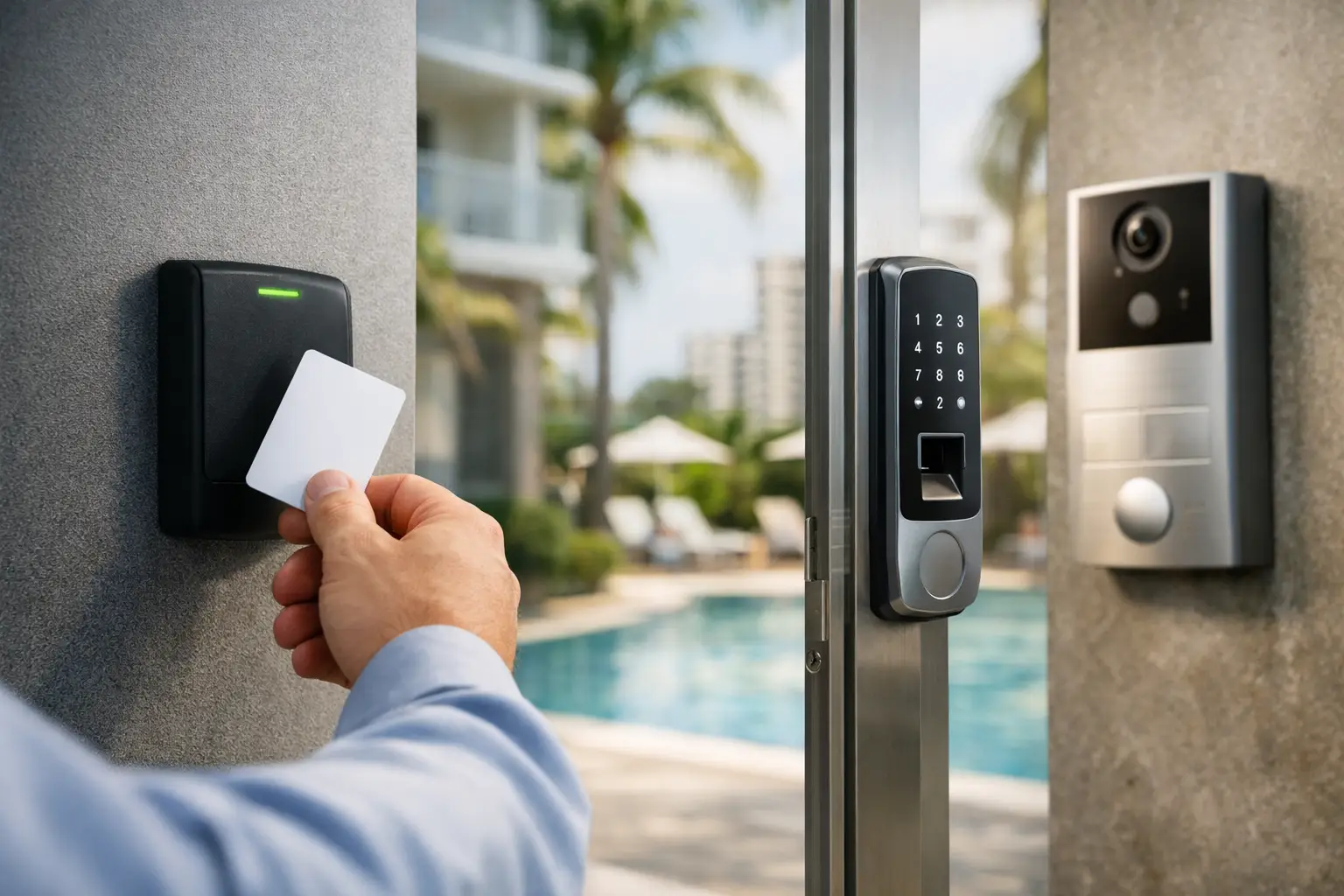
A lost key used to mean calling a locksmith. A former employee leaving used to mean collecting keys and hoping every copy came back. For a busy office, apartment community, school, or multi-site business, that approach creates gaps that are difficult to track and expensive to fix.
Current access control trends are moving properties away from unmanaged mechanical keys and toward systems that show who entered, where they went, and when access changed. The goal is not to add technology for its own sake. It is to give owners, managers, and facility teams better control over daily operations without making entry harder for authorized people.
Access Control Trends Are Becoming More Operational
The strongest trend in access control is not one device or credential type. It is the move toward systems that support real operating workflows. Property managers need to onboard tenants, contractors, and staff quickly. Business owners need to limit access by role and schedule. Facility operators need a clear record when an incident occurs.
Modern systems are being selected based on how well they fit those requirements. A door reader is only one part of the solution. The management platform, credential process, door hardware, network connection, camera coverage, and service plan all affect whether the system works reliably over time.
For Florida properties, that planning matters even more. High humidity, rain exposure, salt air in coastal markets, frequent tenant turnover, and storm-related power or network interruptions can all influence equipment selection and installation methods. A practical access control design accounts for the site conditions, not just the product specifications.
Mobile Credentials Are Replacing More Physical Cards
Key cards and fobs remain useful, especially in environments where employees do not use smartphones during work. But mobile credentials are now a standard consideration for new installations and upgrades. Instead of carrying another plastic card, an authorized user can use a smartphone to open an approved door.
For managers, the advantage is speed. A new employee, resident, vendor, or temporary contractor can receive a credential remotely in many system configurations. When access needs to end, it can be removed without waiting for someone to return a card or fob.
Mobile access is not automatically the right answer for every door. Some users may not have compatible devices, and some facilities need physical backup credentials for safety, convenience, or continuity. The best approach is often a mixed credential strategy: mobile access for daily users, cards or fobs for backup, and structured visitor credentials for short-term access.
Convenience Still Needs Clear Rules
A mobile credential does not solve a weak access policy. Teams still need to decide who approves access, which doors each role can use, and when those permissions expire. Without those rules, a modern system can simply make disorganization faster.
A well-configured platform should make those decisions easy to apply. For example, a cleaning crew may have access to common areas after business hours but not executive offices. A delivery vendor may have access to a loading entrance during a defined time window. Those permissions should be assigned intentionally rather than handled through shared credentials.
Cloud Management Is Changing Day-to-Day Administration
Cloud-managed access control has gained traction because it reduces the need to manage every routine change from a local server or a dedicated on-site workstation. Authorized administrators can often add users, adjust schedules, review activity, and manage multiple locations from a browser or mobile app.
This is particularly useful for property managers and business owners who oversee sites in Miami, Orlando, Tampa, or beyond. A centralized platform can provide a consistent way to manage access across offices, gates, amenity spaces, storage rooms, and other controlled areas.
The trade-off is that cloud access control depends on thoughtful network planning and vendor selection. Internet reliability, cybersecurity controls, user permissions, data ownership, and ongoing subscription costs should all be reviewed before installation. The right system should also have a plan for how doors operate during a network interruption. Life safety and egress requirements always come first.
Video and Access Events Are Being Connected
Access event history becomes far more useful when it can be reviewed alongside video. If a door is forced open, propped open, or accessed outside normal hours, staff should be able to investigate the event quickly instead of searching through separate systems and timelines.
Integration does not mean every camera and every door needs a complicated automation rule. It means the systems should provide useful context. A door event tied to nearby video can help confirm whether a credential was used appropriately, whether a visitor entered with an authorized person, or whether a door hardware issue needs service.
For commercial properties, this can improve incident response and reduce the time spent sorting through incomplete information. For residential communities, it can support a more organized process for managing shared entrances, amenity areas, package rooms, and service access.
Visitor Access Is Getting More Structured
Visitor management is another area receiving more attention. Front desks, leasing teams, offices, and gated properties often need to allow entry for guests, vendors, delivery personnel, maintenance providers, and prospective tenants. A casual process can leave staff relying on verbal instructions, temporary keys, or credentials that stay active longer than intended.
Newer access control workflows can issue temporary credentials with defined start and end times. Depending on the site, visitors may receive a mobile pass, a temporary code, or a printed credential. The specific method matters less than the control behind it: access should be limited to the necessary doors and automatically expire when the visit is over.
This is also where convenience and security need to be balanced. A system that is too restrictive creates bottlenecks at the entrance. A system that is too open makes it hard to know who is on the property. Clear visitor rules, appropriate entry hardware, and a simple staff process are usually more effective than adding complexity.
Biometrics Are Growing, but Not Everywhere
Fingerprint, facial, and other biometric technologies are becoming more common in certain high-security or high-throughput environments. They can reduce dependence on physical credentials and may help prevent credential sharing. However, biometrics are not a universal upgrade.
Privacy expectations, applicable laws, enrollment requirements, user acceptance, and the consequences of a false match all need careful consideration. In many offices, residential properties, and small businesses, mobile credentials or card-based systems offer the right level of control with fewer operational concerns.
Biometrics make the most sense when the security requirement clearly justifies the added complexity. Server rooms, restricted facilities, sensitive records areas, and controlled industrial spaces may have different needs than a typical office suite or community clubhouse.
Door Hardware Is Part of the Security Plan
One of the most overlooked access control trends is the increased focus on the door itself. A reader and software platform cannot compensate for a weak frame, failing closer, incorrect strike, misaligned latch, or improperly configured exit hardware.
Access control projects work best when electrical, mechanical, life-safety, and operational requirements are reviewed together. That includes selecting the correct locking hardware, providing reliable power, planning cable paths, protecting exterior components, and confirming code-compliant free egress.
This is where a full-service low-voltage contractor can simplify implementation. Instead of treating readers, cameras, intercoms, network equipment, and door hardware as unrelated scopes, the project can be planned as one connected property system.
Planning for Service Matters as Much as Installation
Access control is not a one-time purchase. Credentials change, doors wear, tenants move, employees leave, and software settings need periodic review. A system that is easy to manage on day one can become difficult if no one owns the ongoing process.
Before choosing a platform, decide who will administer users, who can approve permission changes, how lost credentials are handled, and when access reports are reviewed. It is also worth confirming how service requests will be managed when a door stops locking correctly or a reader loses communication.
The best access control design is the one your team can operate confidently six months after installation. Start with the doors that create the greatest risk or operational friction, establish clear access rules, and build from there as the property’s needs change.