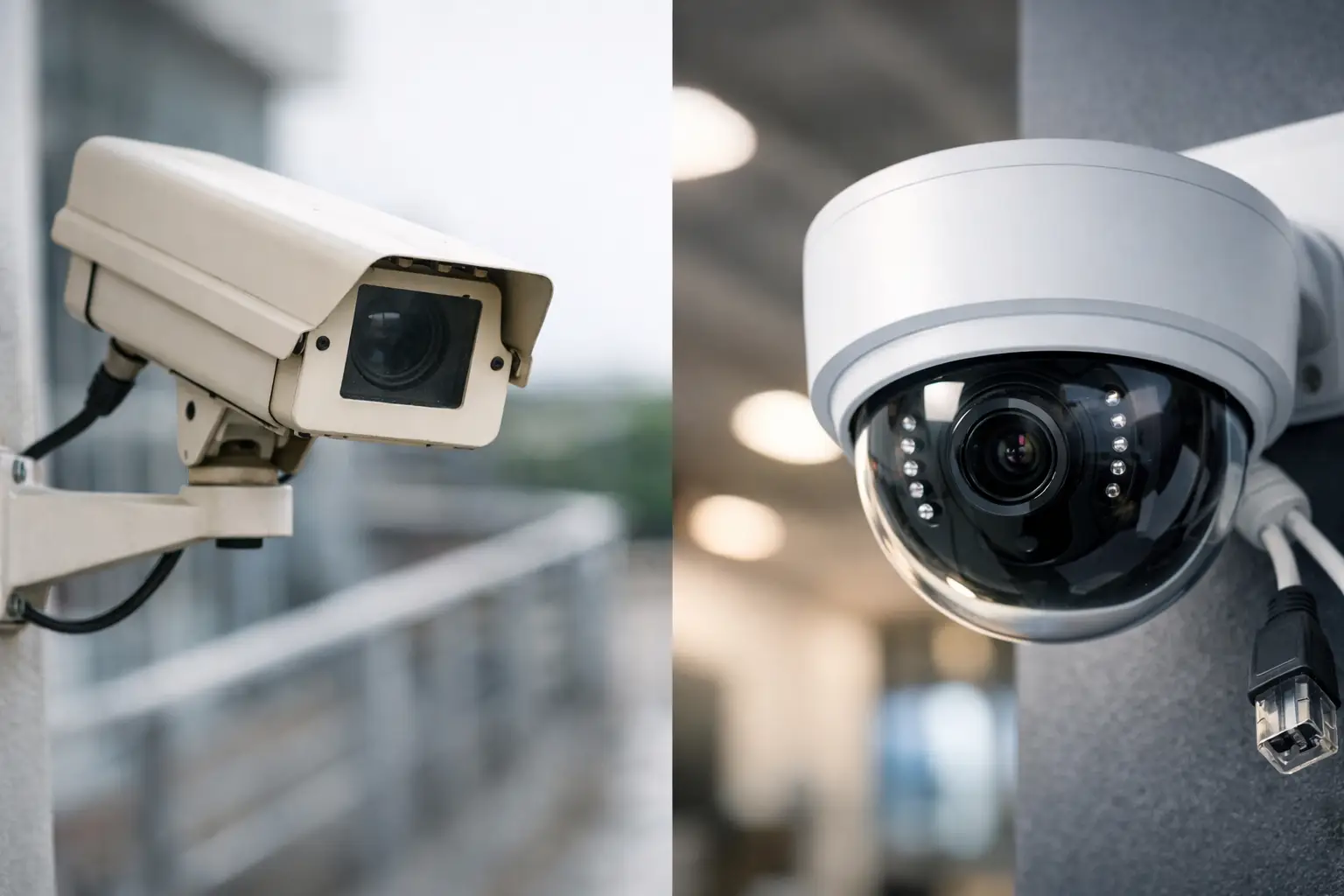
A camera system is only useful when it captures the detail you need, records reliably, and stays manageable after installation. The decision between analog versus IP cameras affects all three. For a small property with existing coaxial cable, analog may be the efficient choice. For a growing business that needs detailed coverage, remote management, and flexible expansion, IP cameras often make more sense.
The right answer is not simply “newer is better.” It depends on the building, the current wiring, the coverage goals, network capacity, and who will be responsible for using the system every day.
What separates analog and IP cameras?
Analog cameras send video over coaxial cable to a digital video recorder, usually called a DVR. Modern analog systems are not limited to the fuzzy, low-resolution footage many people associate with older CCTV. HD-over-coax formats can deliver clear high-definition video while using existing coax runs.
IP cameras are network devices. Each camera converts video into digital data and sends it across a local network, typically to a network video recorder, or NVR. Many IP cameras receive power through the same Ethernet cable that carries their data, using Power over Ethernet, or PoE.
That difference in signal path changes how each system is installed, expanded, viewed, and maintained.
Analog versus IP cameras: the practical differences
Image quality is usually the first comparison point. IP cameras generally offer a wider range of resolutions, including high-megapixel options that can cover larger areas while retaining more detail for digital zoom. This can be valuable at warehouse entrances, parking areas, retail floors, gates, and other locations where identifying a face, license plate, or transaction detail matters.
Modern analog HD cameras can also produce strong footage, particularly when the camera is positioned correctly and the scene is well lit. For straightforward coverage of doors, hallways, driveways, or small offices, an analog system can provide the necessary visibility without adding a larger network infrastructure project.
IP systems have an advantage in camera-level functions. Depending on the equipment selected, they can support features such as people and vehicle detection, line crossing alerts, object classification, two-way audio, and more precise remote configuration. These functions can reduce nuisance notifications and make recorded footage faster to search.
Analog systems are typically more straightforward at the camera level. They are often a practical fit when the goal is continuous recording and dependable visual coverage rather than advanced analytics. Features vary by manufacturer, so system design should start with what the property needs to accomplish, not a generic feature checklist.
Wiring and installation impact
Existing cable is often the deciding factor. If a home, office, or retail location already has functional coaxial cable routed to camera locations, upgrading to modern analog cameras and a compatible DVR may avoid opening walls, running new pathways, or adding network switches. That can control labor costs and shorten the project timeline.
IP cameras usually require Cat5e or Cat6 Ethernet cabling, unless a wireless design is appropriate for a specific location. A properly planned PoE system can be clean and efficient because one cable provides both power and data. It also makes centralized power backup more manageable when the recorder and PoE switch are connected to an appropriately sized uninterruptible power supply.
Wireless IP cameras can be useful for difficult locations, but they should not automatically replace wired cameras. Wi-Fi signal strength, interference, bandwidth, and power availability all affect performance. For critical coverage points, a hardwired connection is usually the more dependable design.
Cost is more than the camera price
Analog equipment can have a lower initial cost, especially when existing coax cable can be reused. The cameras, DVR, and installation approach may be a sensible way to upgrade an older system without rebuilding the property’s cabling infrastructure.
An IP system may cost more upfront because it can require network cabling, PoE switches, higher-capacity recording equipment, and additional configuration. But the value can be better over time if higher resolution allows fewer cameras to cover an area, if analytics save staff time, or if the system needs to expand across multiple buildings.
Storage also deserves attention. Higher-resolution cameras and longer retention periods require more hard-drive capacity. Motion-based recording, intelligent event filtering, frame rate settings, and compression technology all affect how long footage remains available. A system that records excellent video for only a few days may not meet a business’s operational or investigative needs.
When analog cameras are the better fit
Analog is still a practical choice for many properties. It is especially effective when an existing coaxial infrastructure is in good condition and the system needs a focused upgrade rather than a complete redesign.
A homeowner replacing an outdated DVR system may benefit from modern HD analog cameras at entry doors, along a driveway, and around the backyard. A small commercial site with fixed camera locations and basic monitoring needs may also get the results it needs from analog equipment.
Analog can be a good fit when the priority is predictable coverage, simple operation, and a controlled budget. It is also useful where pulling new Ethernet cable would be disruptive or expensive. The trade-off is less flexibility for advanced features, very high-resolution coverage, and future integration with broader network-based technology.
When IP cameras are worth the investment
IP cameras are often the stronger choice for properties with complex coverage needs or long-term growth plans. They work well for businesses, multi-unit properties, gated communities, schools, warehouses, and larger homes where camera quality and centralized control need to scale.
For example, one high-resolution IP camera may provide useful coverage across a broad lobby or loading area where several lower-resolution cameras would otherwise be required. Cameras can be configured and monitored through a centralized interface, while authorized users can view live video and review events remotely.
IP systems also fit naturally into connected-property projects. Video surveillance can be planned alongside access control, intercoms, alarm systems, structured cabling, and smart automation. This creates a cleaner operating model than treating every security component as a separate project.
The trade-off is that IP systems demand more planning. The network must have adequate bandwidth, correct switch capacity, secure configuration, and reliable power. Cameras should be placed on a properly managed network, not simply added to an already overloaded office Wi-Fi connection.
Do not overlook reliability and cybersecurity
Both camera types need professional installation practices to deliver reliable footage. Camera placement, lighting, weather protection, recording health, and power backup often matter as much as the model number on the box.
In Florida, outdoor equipment must also handle heat, humidity, rain, and storm-related power issues. Exterior cameras should be rated for their environment, mounted with the right hardware, and protected with appropriate surge protection. A poor outdoor connection can cause intermittent video, even when the camera itself is high quality.
IP systems add cybersecurity responsibilities. Default passwords should be changed, remote access should be set up securely, firmware should be maintained, and user permissions should match each person’s role. A camera network should be organized so that surveillance equipment does not become an overlooked entry point into a business network.
Analog systems are less network-dependent at the camera level, but DVR remote access still needs to be secured. Convenience should never mean leaving a recorder exposed with weak credentials or outdated settings.
How to choose the right system for your property
Start with the questions that affect daily performance: What details must the camera capture? How many days of recording are required? Is there usable coaxial cable already in place? Will the system need to grow? Who needs remote access, and what other technology must it work with?
A site walk is more valuable than choosing cameras from a specification sheet. During planning, a security contractor can identify blind spots, test existing cable, evaluate lighting, calculate storage needs, and determine whether the network can support an IP design. This avoids common problems such as a camera aimed too high to identify visitors or a recorder sized for far less retention than expected.
For a simple replacement project, analog may deliver the most efficient result. For a property that needs sharper coverage, smarter alerts, scalable management, and integration with access or automation systems, IP is often the better operational investment.
The best camera system is not the one with the longest feature list. It is the system that records the right areas, preserves usable evidence, and remains easy to manage when an incident requires immediate attention.