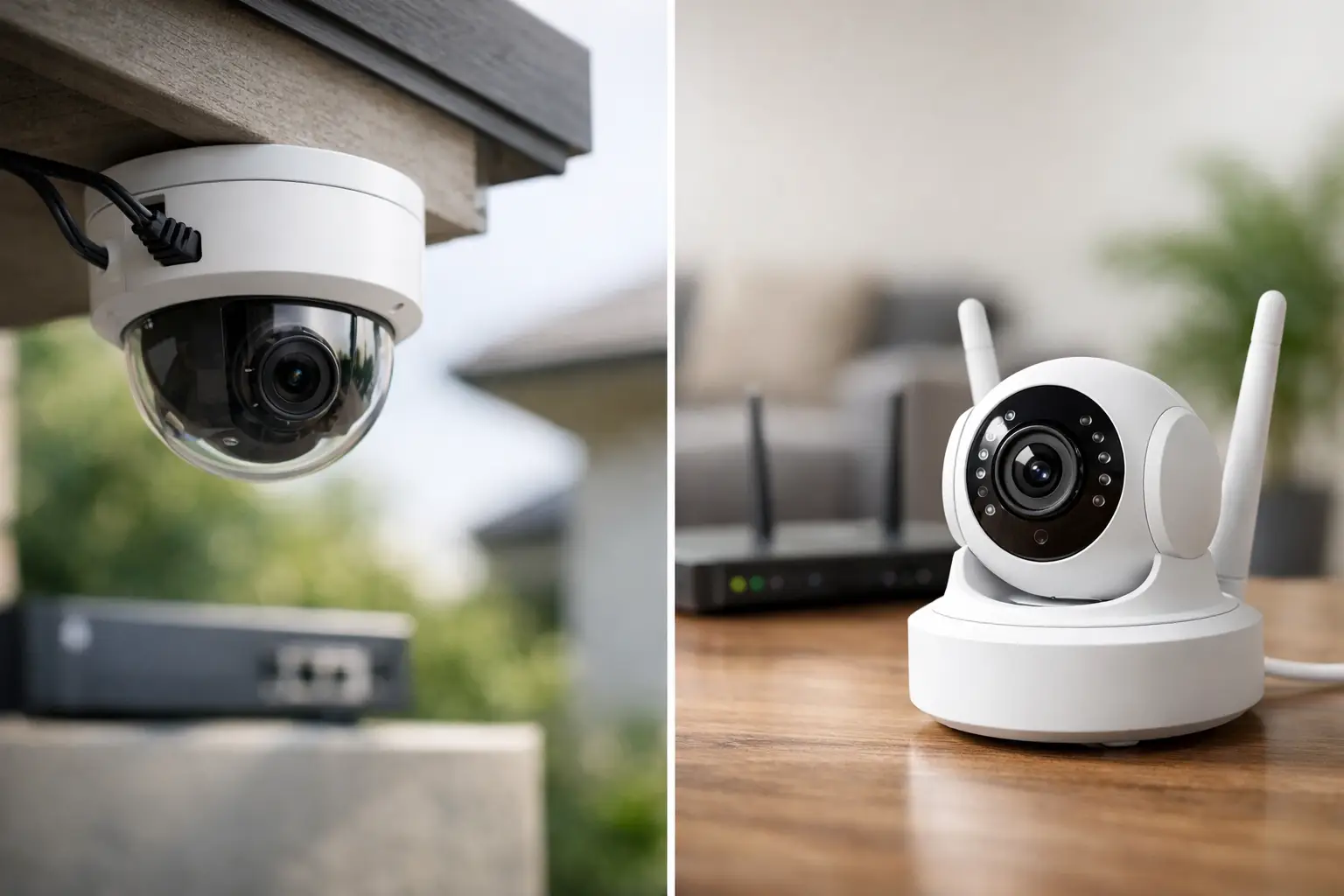
A camera that drops offline when a delivery arrives is not providing much security. That practical concern sits at the center of PoE cameras versus WiFi cameras: one option prioritizes a wired, managed connection, while the other prioritizes placement flexibility and a faster initial setup. Neither is automatically right for every property.
For homeowners, the decision often comes down to construction access, camera locations, and how much reliability they expect from the system. For property managers and business owners, the bigger questions are scalability, network control, retention requirements, and serviceability. The best answer starts with the building and the security objective, not the camera box.
How PoE Cameras Work
PoE stands for Power over Ethernet. A PoE camera receives power and network data through one Ethernet cable, typically Category 5e or Category 6. That cable runs back to a PoE network switch or a network video recorder (NVR) with built-in PoE ports.
The benefit is straightforward: every camera has a physical data connection and does not need a separate electrical outlet at the mounting location. A properly designed PoE system can centralize recording, camera power, network settings, and troubleshooting in one equipment location.
This setup is particularly useful for permanent exterior cameras, commercial facilities, multi-camera residential systems, parking areas, entry points, and any location where predictable performance matters. If the network video recorder and network equipment are protected by a battery backup, cameras can remain operating through short power interruptions as well.
PoE does require cable pathways. In a new build, remodel, or property with accessible attics and ceilings, pulling cable is usually efficient. In finished concrete construction, high-rise units, historic buildings, or sites with limited access above ceilings, the labor can be more involved. Installation cost is often higher at the beginning, but the infrastructure is built for long-term use.
How WiFi Cameras Work
WiFi cameras send video over the property’s wireless network. Most still need local power from an outlet or low-voltage adapter, unless they use a rechargeable battery or solar charging accessory. They are often installed through a mobile app and can be an effective choice where running Ethernet is impractical.
Their main advantage is speed. A camera can be placed where WiFi coverage and power are available without opening walls or routing cable across a property. This makes WiFi useful for renters, temporary locations, detached sheds, single-camera needs, and areas where a wired installation would be disproportionate to the risk.
However, wireless video depends on conditions outside the camera itself. Distance from the router, concrete walls, metal structures, neighboring wireless networks, device congestion, and internet equipment placement can all affect performance. A camera may show a strong signal in a phone app yet struggle during periods of heavy network use.
Battery-powered WiFi cameras add another variable: maintenance. They can be convenient, but batteries need charging or replacement, and frequent motion activity can shorten runtime. For a low-traffic side gate, that may be acceptable. For a busy commercial entrance, it is usually not the preferred operating model.
PoE Cameras Versus WiFi Cameras: Reliability
For reliability, PoE generally has the advantage. A hardwired connection is not subject to typical wireless interference, and a camera’s network path is easier to identify and test. When a PoE camera has an issue, a technician can check cable continuity, switch power, recorder status, and network configuration in an organized sequence.
WiFi cameras can be reliable when the wireless network is designed for them. The key phrase is designed for them. A consumer router placed in a closet at one end of a home may not provide dependable coverage to a far-side driveway, rear patio, or detached building. Adding access points, improving router placement, and separating smart devices onto an appropriate network can improve results significantly.
Internet service is another distinction. Many WiFi camera platforms rely heavily on cloud access for recording, alerts, and remote viewing. If the internet connection fails, local camera operation may be limited depending on the product and configuration. A PoE system with local NVR recording can continue recording on-site even when internet service is down, though remote viewing will not be available until the connection returns.
That distinction matters during severe weather, construction activity, or provider outages. Florida properties also need to account for storms, power events, and outdoor exposure. For critical coverage, a local recorder, properly rated equipment, surge protection, and battery backup are more meaningful than relying on an app alone.
Installation Cost Is Not the Whole Cost
WiFi systems often have a lower entry cost because there is less labor at installation. That can make sense for a small home system with one or two cameras. It can also be the right choice when there is no reasonable path to run cable.
PoE systems generally cost more upfront because of structured cabling, equipment selection, recording hardware, and professional configuration. Yet cost should be evaluated over the expected life of the system. If a wireless camera needs repeated battery maintenance, experiences coverage problems, or requires replacement as a cloud platform changes, the lower initial price may not be the lower operational cost.
For commercial properties, a wired system often becomes more cost-effective as the camera count grows. One NVR, PoE switching, organized cable labeling, and centralized storage provide a cleaner foundation than managing numerous individual wireless devices. The same principle applies to larger homes with cameras at multiple perimeter points.
Video Quality, Recording, and Alerts
Image quality is not determined solely by whether a camera uses PoE or WiFi. Resolution, lens choice, sensor size, low-light performance, frame rate, bitrate, and scene lighting all matter. A poorly positioned 4K camera can still miss the detail needed to identify a person or vehicle.
What PoE more consistently supports is high-bandwidth, continuous recording across multiple cameras. Wired networks are better suited to moving larger video files without competing as heavily with phones, streaming devices, and other wireless equipment. This is valuable when a site needs 24/7 recording rather than only motion-triggered clips.
WiFi cameras are commonly built around motion events and cloud notifications. That is convenient for checking a package delivery or receiving an alert at a secondary door. It may be less appropriate for a business that needs to review an incident over several hours or verify activity across several camera views.
Before selecting either system, define what must be captured. A front door may need face-level identification. A driveway may need vehicle movement and license plate context. A warehouse may need broad coverage, while a cash-handling area may require detailed, continuous recording. The camera type follows those requirements.
When WiFi Is the Better Choice
WiFi is not a lesser option by default. It is often the sensible choice for a small, targeted project with strong coverage and a clear maintenance plan. It also works well when the camera location is difficult to cable, the system is temporary, or the property owner needs a simple way to add coverage without a construction project.
A homeowner may choose WiFi for an interior nursery, a temporary renovation area, or a detached space that already has strong wireless coverage and convenient power. A property manager may use it for a short-term monitoring need where permanent infrastructure is not justified.
The important step is to test signal quality at the exact mounting location, not just inside the building. Consider the route between the camera and access point, expected WiFi traffic, and whether the camera remains usable if internet service is interrupted.
When PoE Is the Better Choice
Choose PoE when security coverage is permanent, camera count is growing, continuous recording is required, or an outage would create a meaningful blind spot. It is the stronger fit for building perimeters, offices, retail locations, communities, warehouses, medical or professional facilities, and homes where owners want a centralized system rather than a collection of separate devices.
PoE is also a practical choice when a property is already being wired for access control, alarms, audio, networking, or smart technology. Coordinating low-voltage work at the same time reduces duplicate labor and keeps equipment locations organized. A single project plan can account for cable routes, rack space, electrical backup, remote access, and future camera additions.
Plan for the Property You Will Have Next Year
The most useful camera system is one that still fits after a tenant changes, a business adds an entrance, or a homeowner decides to cover the side yard. Before installation, map the areas that need observation, identify the level of detail required, and decide where recording equipment should live.
For a wired deployment, leave capacity in the switch, recorder, conduit, and equipment enclosure. For WiFi, verify coverage throughout the full property and treat network design as part of the security system, not an afterthought. A well-planned system gives you control when an incident happens and keeps expansion from becoming a second, disconnected project.
1 Stop Security can evaluate cabling access, camera objectives, network conditions, and future requirements as one coordinated low-voltage project. The right choice is the one that provides dependable coverage without creating unnecessary maintenance or operational gaps.