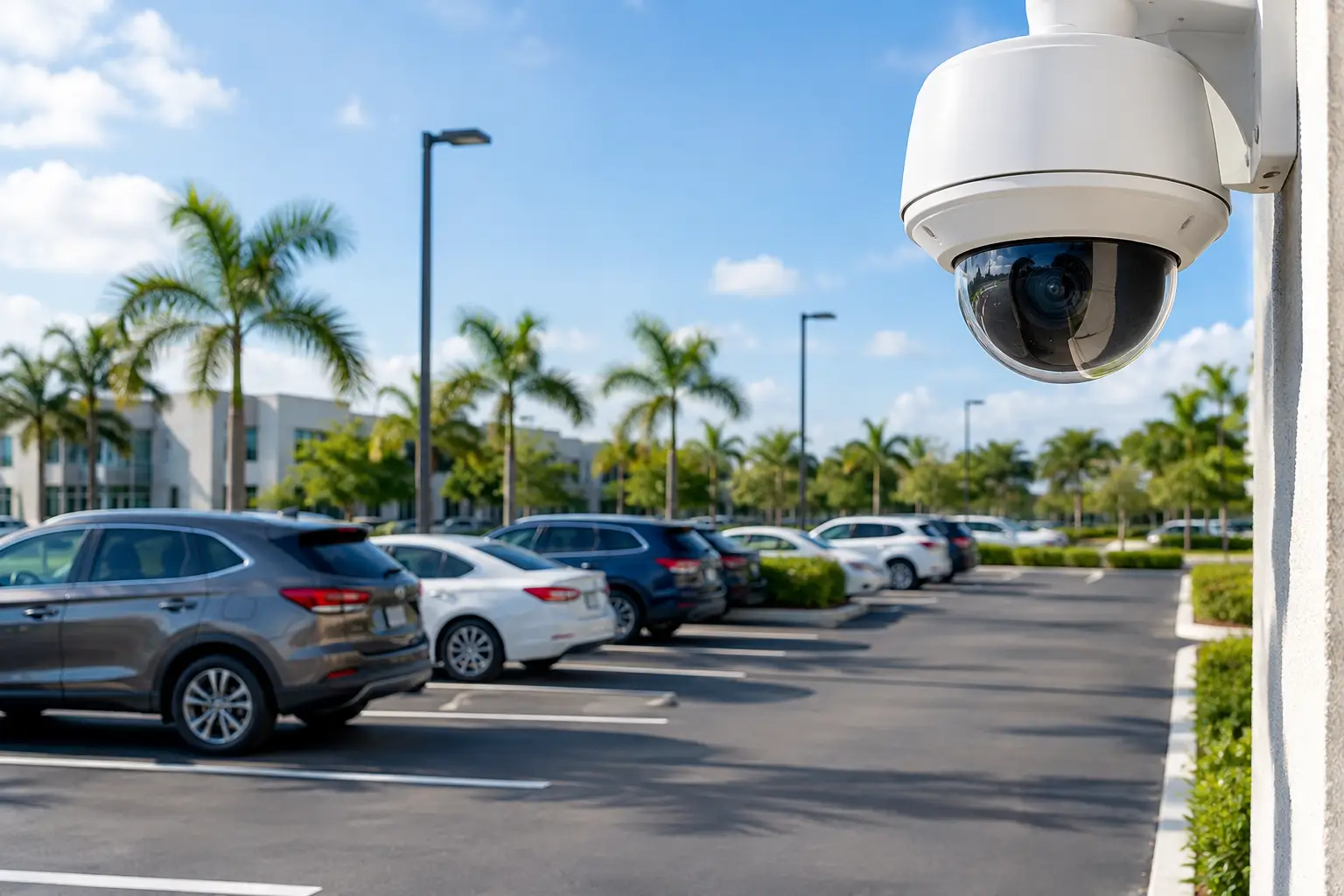
A parking lot can become a property’s least controlled area after business hours. It is open, exposed, and often shared by employees, tenants, customers, delivery drivers, and visitors. The top parking lot security solutions address that gap by combining visibility, deterrence, controlled entry, and a clear response process.
For Florida businesses and multifamily properties, the right setup must also handle heavy rain, heat, humidity, changing daylight, and high traffic. A camera mounted in the wrong location or a gate without a reliable access plan can create a false sense of security. The goal is not to install the most equipment. It is to create a system that helps staff see what is happening, manage who enters, and act quickly when an issue occurs.
Start With the Risks in Your Parking Area
Parking lot security planning should begin with a walkthrough, not a product catalog. Property managers should identify where people enter on foot and by vehicle, where visibility drops after dark, where vehicles can hide, and which areas generate the most complaints or incidents.
A medical office may need after-hours employee access and clear visitor routing. An apartment community may need to protect resident vehicles, package areas, and pedestrian paths. A retail center may be more concerned with loitering, theft, and traffic flow. The equipment can overlap, but the operating plan should reflect the property’s actual risks.
Also consider what happens when an event is detected. Who receives an alert? Can they verify it through video? Can they communicate with a visitor or contact law enforcement with useful information? Security hardware is most effective when those decisions have been organized in advance.
Top Parking Lot Security Solutions That Work Together
The strongest parking lot security systems use layers. Each component covers a different point of failure, so one device does not have to do every job.
Surveillance Cameras for Coverage and Verification
Security cameras are the foundation for most lots because they provide live visibility and recorded evidence. Fixed cameras work well at entrances, walkways, dumpsters, loading areas, and rows where activity needs to be monitored consistently. Pan-tilt-zoom cameras can cover larger areas, but they should not replace fixed cameras at critical choke points. If a PTZ camera is facing one direction, it is not recording detail somewhere else.
Camera placement matters more than camera count. A proper design captures usable faces at pedestrian entrances, license plates at vehicle lanes, and broad views across the lot. It should also account for glare from headlights, shadows under canopies, and bright Florida sunlight at sunrise and sunset.
High-resolution cameras can improve detail, but higher resolution also increases storage and network requirements. A system should be designed around the footage you need to retrieve, how long it needs to be retained, and how quickly authorized staff can find it.
License Plate Recognition at Vehicle Entries
License plate recognition, often called LPR, gives properties a practical way to document vehicle movement. It can log plates entering and leaving, support investigations, and create alerts for approved or blocked vehicle lists.
LPR is particularly useful for gated communities, private lots, distribution facilities, and commercial sites with defined vehicle entrances. It performs best when cameras are positioned for a controlled approach lane. Trying to capture every plate from a wide, fast-moving parking area usually produces inconsistent results.
Properties should set clear rules for plate data, retention, access, and any visitor registration process. LPR can improve oversight, but it needs privacy-conscious administration and realistic expectations about reading plates in bad weather, at high speed, or when a plate is obstructed.
Access Control, Gates, and Visitor Entry
A gate only adds security when access is managed consistently. Keypads, credentials, mobile access, remote controls, and video intercoms can all be appropriate depending on the site. The right choice depends on who needs entry, how often access changes, and whether visitors require assistance.
For a smaller business lot, a keypad and video intercom may be enough. For a larger facility, access credentials can create an audit trail and make it easier to remove access when an employee or vendor relationship ends. Apartment properties may benefit from mobile credentials and a managed guest-entry process.
Gates create trade-offs. They can reduce unwanted vehicle access, but they can also cause traffic backups, tailgating, and frustration if they are not sized and programmed correctly. Emergency access, fire code requirements, delivery procedures, and gate maintenance all need to be part of the installation plan.
Lighting That Supports Cameras and People
Poor lighting creates security problems even when cameras are installed. People feel less safe in dark areas, and video quality suffers when lighting is uneven or aimed directly into a camera lens.
LED area lighting, pole fixtures, wall packs, and pathway lighting can improve visibility across parking spaces and walking routes. The goal is even, usable light at entrances, stairwells, elevators, payment stations, and other high-use areas. Motion-based lighting can reduce energy use in low-traffic zones, but sudden lighting changes may not be appropriate for every lot.
Lighting should be reviewed alongside camera placement. A security camera cannot reliably identify a person whose face is hidden in shadow or blown out by a nearby fixture. Coordinating both systems prevents expensive corrections after installation.
Video Intercoms and Emergency Communication
At controlled entrances, video intercoms let staff verify visitors before granting access. They are useful at gates, pedestrian doors, service entrances, and garage entry points. The value is not just convenience. A recorded interaction can give staff context before they decide whether to release a door or gate.
Emergency call stations or clearly marked help points can also be appropriate for larger campuses, garages, hospitals, and multifamily communities. These devices should be placed where people can find them quickly and where cameras can document the surrounding area.
Analytics and Active Monitoring
Modern video analytics can identify line crossing, people in restricted areas, vehicles entering designated zones, or activity after scheduled hours. Used well, analytics reduce the need for someone to watch video screens all day.
They also require careful configuration. A system that sends alerts for every passing shadow, rainstorm, or moving tree will be ignored. Set analytics around specific operational concerns, then test them at different times of day. For higher-risk properties, professional monitoring can add a human review step before escalation. That may be worthwhile when staff cannot respond reliably, but it comes with recurring service costs and defined response procedures.
Design for Daily Operations, Not Just Incidents
Security systems often fail after installation because no one owns the daily workflow. Assign responsibility for adding and removing access credentials, reviewing alerts, checking camera health, and responding to visitor requests. Establish who can export video and how requests from residents, tenants, insurers, or law enforcement are handled.
Centralized management makes this easier. When cameras, access control, gates, intercoms, and alerts are designed as connected systems, property teams spend less time switching between disconnected apps and calling multiple vendors. A single-source contractor can coordinate device placement, low-voltage cabling, network considerations, configuration, and service support under one project plan.
1 Stop Security works with commercial and residential properties that need that organized approach, from initial site review through installation, system setup, and ongoing service coordination.
Avoid Common Parking Lot Security Gaps
Many security upgrades underperform for predictable reasons. Cameras are installed too high to capture faces. Gates are added without a visitor policy. Lighting is replaced without checking camera glare. Recording retention is too short to support an investigation discovered days later. Staff members have shared credentials, making access logs less useful.
Another frequent problem is designing only for the perimeter. A property may secure its vehicle entrance while leaving pedestrian paths, side doors, dumpster areas, and rear exits poorly monitored. A complete assessment follows how people actually move through the site, including the shortcuts they use after dark.
Maintenance is equally important. Camera lenses need cleaning, vegetation needs trimming, gate hardware needs service, and firmware or credential lists need periodic review. Florida weather makes routine inspections especially valuable. Water intrusion, corrosion, lightning exposure, and storm damage can affect equipment that looked fine at the time of installation.
Build a System Around Your Property’s Priorities
The best solution for a small private lot may be a few properly placed cameras, improved lighting, and controlled entry after hours. A larger apartment community or commercial campus may need LPR, access control, intercoms, analytics, and monitored response. Budget matters, but so does the cost of installing equipment that does not solve the daily problem.
Begin with the areas where visibility and control are weakest, then build a system that can expand as the property changes. A clear site plan, dependable installation, and defined ownership will do more for parking lot security than a collection of disconnected devices.